Making is a Difference: Interior Intervention through Bottom-up Co-Creation: The Case of Diepeveen
The interior salon is interpreted as a flexible stage with different alternative orientations where locals can engage in co-creation and developing their identity. As the context research reveals, most locals are immigrants who moved to Diepeveen in the last half-century. Single-parent families, high unemployment, and debt make the community vulnerable. Yet, locals are lovely and cohesive to seek a better life. As their aspirations and the municipality’s agenda, educational programs, including language and vocational training, are planned to be inserted into the neighbourhood. The community suggested that the central historical industrial shed built in the 1910s would be a suitable place for accommodating those prospective programs.
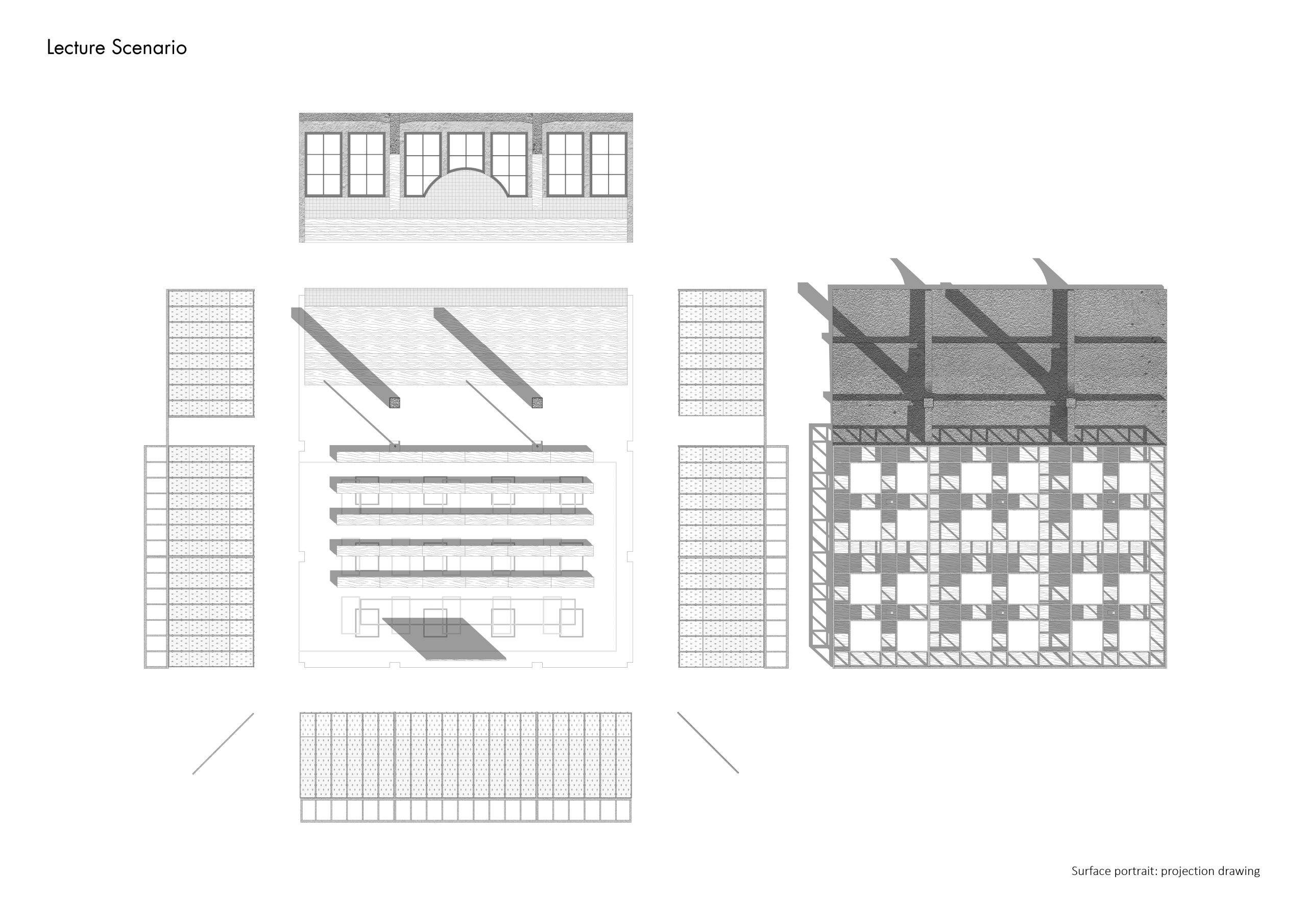
The main salon space is designed to be positioned west of the shed for the proximity to the entrance, the characteristic arch gate, and the outdoor green. The major salon space in the centre will be enclosed by movable panels, enabling itself to merge with adjacent areas so as to fit different programs’ spatial requirements. The integrated panels and the well-equipped crown will climatise the room to ensure an excellent acoustic and thermal environment. Logistically, unused panels will be stored on the other side of the shed, becoming a nice co-created element in the space.
The sliding panels are vital to the project. Their making process and implementation were extensively researched with locals through 1-to-5 models. The panels are designed to be easily made and assembled on-site in the workshop, one of the salon’s programs. The MDF components can be put together easily by glue and nails. The front of the panel is more about architectural expression, while the backside is more technical for operation. Metal hooks are set on the back to fix the panels in the distance, creating a temporary semi-closed interface. The casters at the bottom and the metal balls on the top enable panels to be easily moved. Acoustic pet panels with perforations can be substituted in the way of slipping in and out. Locals are fully empowered to determine the panels’ colours, patterns, and slogans. The collaborative model test proves that the panel system works well – all the elements are light yet robust, simple yet elegant, adaptive to changes, and able to function efficiently in a raw way.
For the spatial quality and atmosphere, the new space is designed to be smoothed out by painting and wrapping in contrast to the roughness of the existing surface. The floor will be painted with colourful strips, implying the positions of furnitures in different configurations. The plinth of the table and wrapped columns will also be coloured in response to the strips, indicating a rising up force from the ground, while the fixed crown hanging on the beams is coming down from the top. In this sense, the panels integrate the space into a whole by connecting and reconciling the two forces. Material-wise, the project developes a restrained way of using MDF boards and pet panels to decorate space, which is beloved by the locals.