Advertisement: Register Now - My Portfolio-Making Studio: Participation in Cultural Heritage Redevelopment
课题背景 | Background
利益相关者积极参与文化遗产(cultural heritage)管理活动的社会重要性与日俱增。联合国教科文组织(UNESCO)的报告Historic Urban Landscape指出:快速且不受控制的发展正在改变城市环境,这可能导致城市遗产的破碎和退化,从而破坏社区价值(community value)。为了应对此威胁,该报告鼓励诸如社区的利益相关者参与城市发展的决策过程(decision-making process)。欧洲委员会(Council of Europe)进一步解释,在遗产治理中社区参与(community participation)将人们与其附近的文化遗产连结并帮助达成价值和行动上的共识,以此建立对遗产环境和所在社区的归属感(sense of belonging)和认同感(sense of identity)。UNESCO 世界遗产公约(World Heritage Convention)也强调了遗产管理中的社区参与能够帮助提升公民的“生活质量(quality of life)”和“福祉(well-being)”。在建筑领域,遗产建筑的再设计(redesign)也需要社区参与来识别、保护和延续遗产价值,同时最大化再设计的附加价值(added value),进而应对再设计可能带来的价值取舍的困境(dilemmas)。然而,如何更透明地使相关社区参与进遗产建筑的再设计并提升参与体验,仍然是建筑学学术和实践中一个难题。
Active stakeholder participation in cultural heritage management is of increasing social importance. UNESCO’s Historic Urban Landscape report points out that rapid and uncontrolled development is changing the urban environment, leading to fragmentation and deterioration of urban heritage, thereby undermining community value. To address this threat, the report encourages stakeholders such as communities to participate in the decision-making process of urban development so as to identify and preserve urban heritage. The Council of Europe further explained that community participation in heritage governance connects people to cultural heritage and helps to reach common ground and consensus on values and actions, establishing a sense of belonging and identity. The UNESCO World Heritage Convention also emphasises that community participation in heritage management can help improve the “quality of life” and “well-being” of citizens. In architecture, the redesign of heritage buildings also requires community participation to identify, preserve and pass on heritage values. What’s more, it maximises the added value of the redesign and resolves the dilemmas of value trade-off that the redesign may bring about. However, how to more transparently involve relevant communities in redesigning heritage buildings and enhancing the participation experience remains a challenge in architectural academia and practice.
课题目标 | Aims and goals
该课题旨在探索将参与式设计方法与建筑遗产再设计方法结合的方式,即开发和检验针对具体社区和建筑遗产的在地化设计方法论和参与式再设计工具(participatory redesign tool),并以此完成对建筑遗产社会价值的调查、对再设计场景(redesign scenario)的模拟和评估及最终的设计成果表达。
The project aims to explore possibilities of integrating participatory design methods with architectural heritage redesign methods, namely developing and testing contextual research-design methodologies and participatory redesign tools for specific communities and cultural heritage sites. This way, the social value will be investigated, identified and assessed, the redesign scenarios will be simulated, compared and evaluated, and the representation methods will be experimented with accordingly.
课题方法 | Methodology
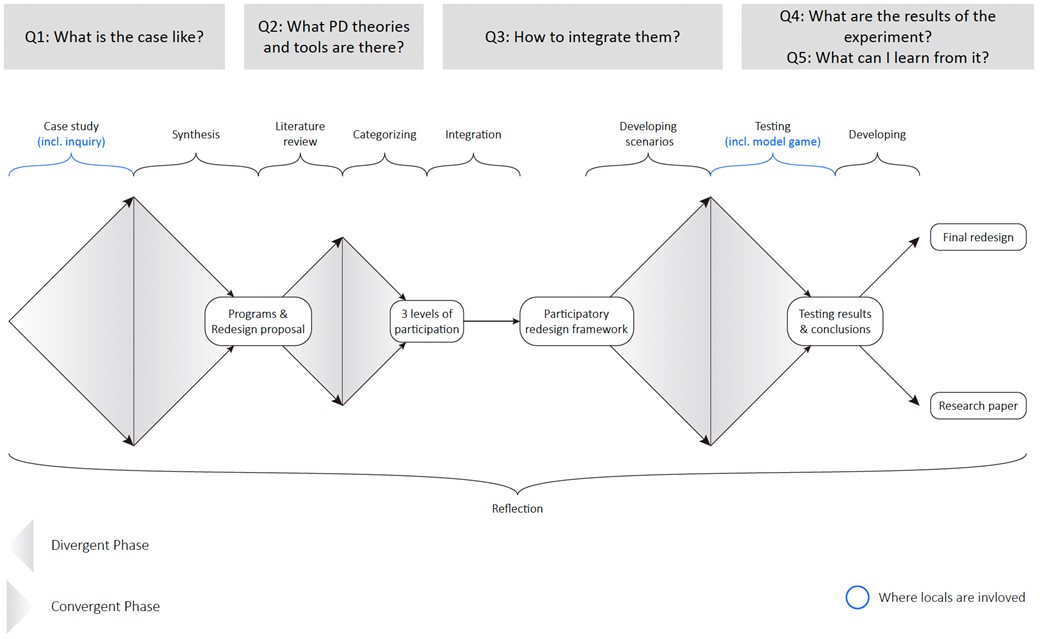
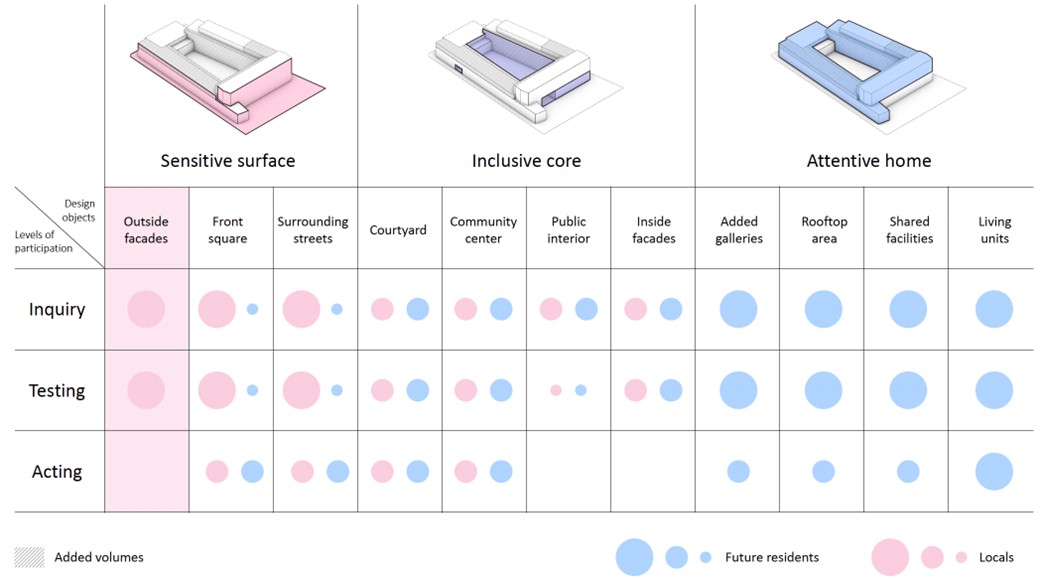
课题鼓励学生在已有设计方法(如下)的基础上根据具体的场地和利益相关者选择最为关键的部分作为研究范围,发展创新的参与式设计的方法和工具并作用于设计。参与式设计(participatory design)指非专家利益相关者(non-expert stakeholder)使用参与式工具介入设计过程的设计方法。自20世纪80年代以来,参与式设计方法在各个设计领域得到了发展,并开发了从交谈到棋盘游戏的多种参与式工具。Plattner, Meinel和Leifer介绍了一种通用的参与式设计方法,包括了一系列发散和收敛的阶段,从范围确定(scoping)到访谈(interviewing),到生成观点(Points of View),再到迭代(iteration)到最终输出(outputs)。Martin和Hannington将类似的方法总结为五个阶段:定义、探索、概念生成、评估、启动和监测。Leung关于城市空间参与式设计的方法包括三个阶段:语境探究、想法综合和测试。总结来说,参与式设计在建筑设计中可以分为询问(inquiry),设计测试(design testing),自搭建(self-building)和管理(management)四个级别,在此过程中2D/3D的物理和数字工具被广泛利用来吸引参与者。
Starting from the existing design methods as below, students are encouraged to choose the most critical part of the project, referring to site and stakeholder conditions, and develop innovative participatory design methods and tools. Participatory design refers to the design method in which non-expert stakeholders are involved in the design process using participatory tools. Since the 1980s, participatory design methods and tools, from conversation to board games, have been developed in various design fields. Plattner, Meinel, and Leifer introduce a general participatory design approach that includes a series of divergent and convergent stages, from scoping to interviewing to generating Points of View to iteration to outputs. Martin and Hannington summarise similar approaches into five stages: definition, exploration, concept generation, evaluation, and launch and monitoring. Leung’s approach to participatory design of urban space includes three stages: contextual inquiry, idea synthesis and testing. In summary, participatory design in architectural design can be divided into four levels: inquiry, design testing, self-building and management. 2D/3D physical and digital tools are widely utilised to attract participants.
建筑遗产再设计侧重于对遗产现有价值和设计带来的附加价值的评估和权衡。Roders定义了文化遗产的八大类价值:社会价值(social value),经济价值(economic value), 政治价值(political value), 历史价值(historic value), 美学价值(aesthetical value), 科学价值(scientific value), 年代价值(age value)和生态价值(ecological value)。围绕这些价值的挖掘和判定,编年制图(chrono-mapping)作为第一步的遗产分析,将遗产场地的建设和演变历史从文献研究(archival research)和编史语言学研究(historiographical research)中阐释清晰。第二步,遗产具体属性(attribute),包括物质(tangible)和非物质(intangible)的属性,其价值通过文献译码(coding)、参与式问询(inquiry)等方法识别并分级表达在价值制图(value mapping)中,为设计决策提供依据,这些带有价值的遗产属性又会在第三步中结合利益相关者的视角进一步评估和可视化其维护、修复、改造和扩建的优先级。最后一步将会定义价值取舍的困境并做出最终的设计决策。
Architectural heritage redesign focuses on assessing and balancing heritage’s existing value and the added value brought by the design. Roders defines eight primary cultural heritage values: social value, economic value, political value, historic value, aesthetic value, scientific value, age value and ecological value. Chrono-mapping is the first step in digging and identifying these values. The history of the construction and evolution of heritage sites is clarified by archival and historiographical research. Second, heritage attributes, including tangible and intangible attributes, are presented in value mapping through coding, participatory inquiry and other methods, formulating a basis for the later decision-making discussion. In the third step, these heritage attributes with values are further evaluated and visualised to prioritise the needs for maintenance, restoration, renovation and expansion, referring to stakeholder perspectives. The final step will define the value trade-off dilemma and make final design decisions.
课题步骤及进度要求 | Phases
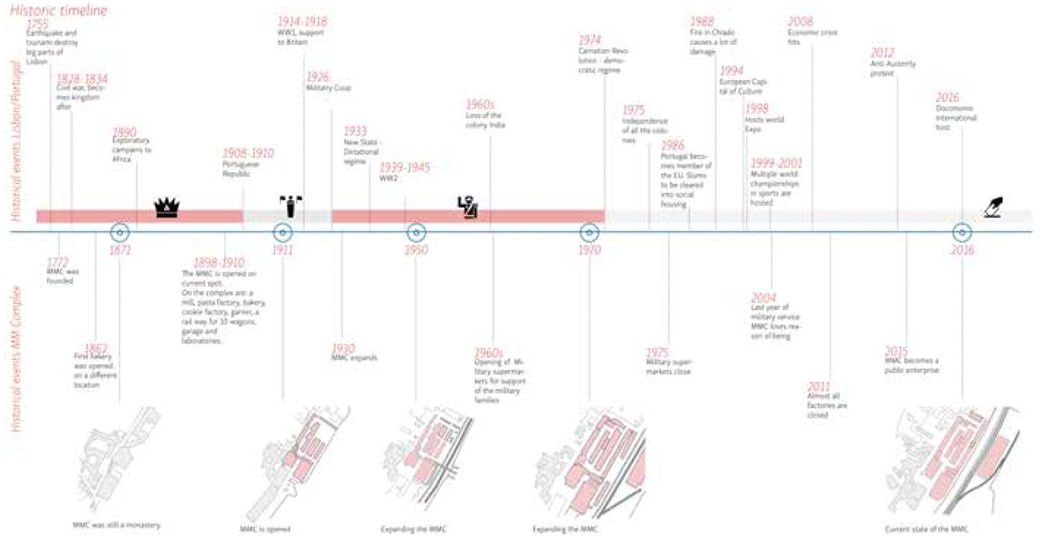
课题第一阶段(第1-2周)在学生的学校课设/学生熟悉的社区中选择一处社区遗产场地整理相关资料(历史事件、技术图纸、材料状况等),调研其与所在社区的联系(association),社区对于这片场地和具体构件材料的记忆(remembrance)和感知(perception)及对未来再发展的看法。产出:chrono-mapping,material mapping,perception mapping
课题第二阶段(第3周)针对已有材料对场地各部分属性进行价值评估(value assessment)提出针对属性的拆改策略,同时从场地类型、建筑技术、社区需求等角度开发新的功能。产出:value mapping,program diagram
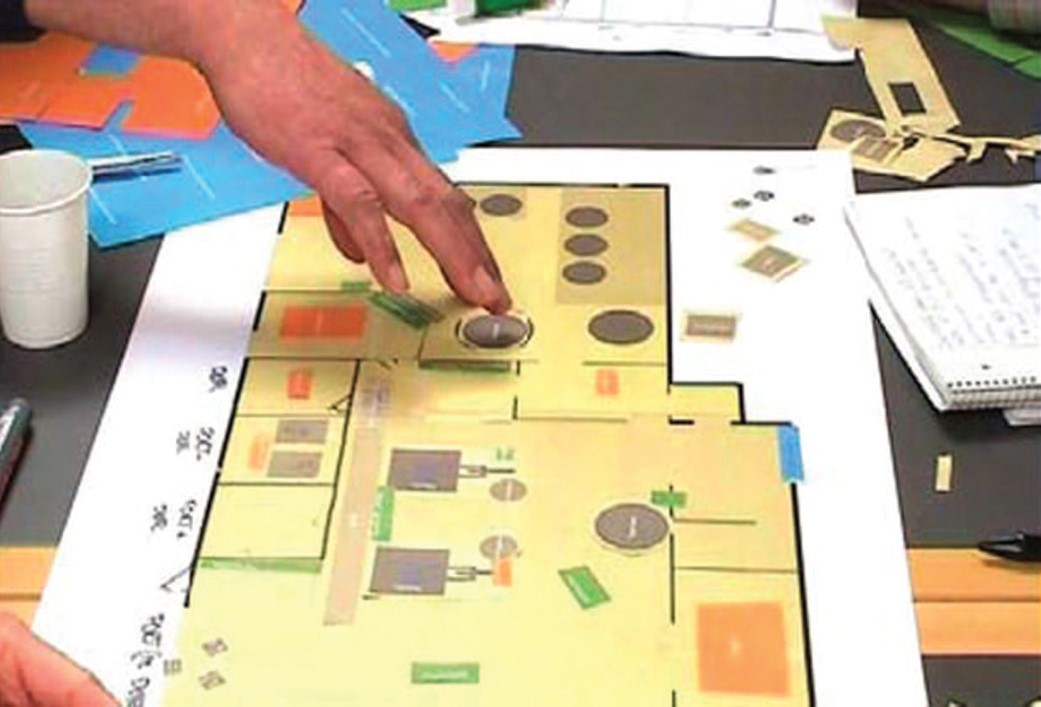
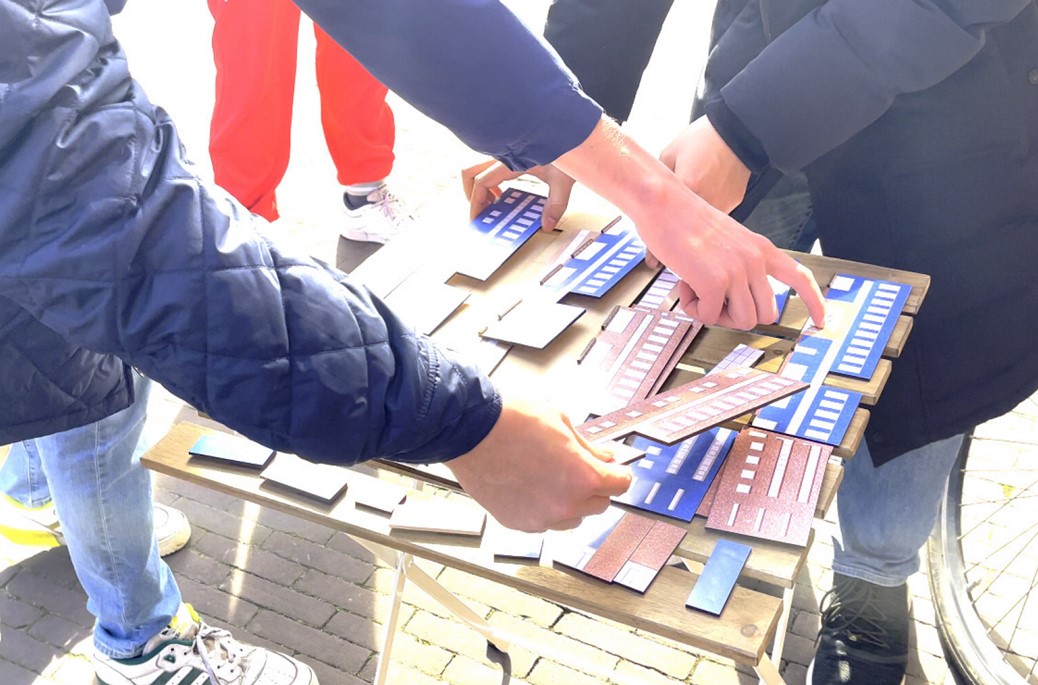
课题第三阶段(4-6周)提出改造提案(redesign proposal),定义场地内的价值取舍困境并定位最关键的部分来使利益相关者介入帮助决策。确定参与者的人口统计学背景(demographic background),开发参与式设计的物理/数字工具并进行试验,收集关于参与过程和结果的数据用以反思和指导设计。产出:redesign proposal,participatory tool,process photos, experiment results
课题第四阶段(7-10周)深化设计,完成图纸表达。产出:redesign plans/sections/elevations,details,sectional perspective,choisy drawing
The first phase (week 1-2): Students will select a community heritage site they might be familiar with or interested in, sort out relevant materials (historical events, technical drawings, material conditions, etc.), and investigate its association with the community, including people’s remembrance and perception of the specific elements and materials and their views on future redevelopment. Expected outcomes: chrono-mapping, material mapping, perception mapping
The second phase (week 3): Based on the materials, students will conduct a value assessment of each part of the site, put forward the demolition and renovation strategies for each attribute, and develop new functions in consideration of site location, heritage typology, construction technology and community needs. Expected outcomes: value mapping, program diagram
The third phase (week 4-6): Students will formulate a redesign proposal that defines the value trade-off dilemma and select the most critical parts to engage stakeholders to help make decisions. Students will collect data on participants’ demographic backgrounds, develop and test physical/digital participatory tools, observe and record the participatory process, and analyse the results to reflect on and guide the design. Expected outcomes: redesign proposal, participatory tool, process photos, experiment results
The fourth phase (week 7-10): Students will develop the design further, including technical details and complete representations. Expected outcomes: redesign plans/sections/elevations, details, sectional perspective, choisy drawing
课题指导 | Instructions provided
1. 遗产分析:围绕学生所选场地和社区,帮助学生学习和掌握遗产分析方法并从中寻找设计出发点和设计依据。
2. 设计提案:帮助学生从社区、空间、文化、技术等多个角度发展合理的设计提案。
3. 社区参与:提供关于社区参与的理论和实践指导,帮助建立对其作用、手段、实验过程、数据分析各个方面的知识框架。
4. 成果表达:帮助学生选择合适的表达工具和表现手法,提升学生的绘图技法、模型制作技法、排版技法等。
1. Heritage analysis: Assist students in learning and mastering the heritage analysis method and finding the starting points for the redesign of the selected site and community.
2. Design proposal: Assist students in developing reasonable design proposals incorporating perspectives such as community, space, culture and technology.
3. Community participation: Provide theoretical and practical guidance on community participation and help build a knowledge framework on participation’s role and methods, experimental process, and data collection and analysis.
4. Representations: Assist students in choosing appropriate representation tools and techniques and improve students’ drawing skills, model-making skills, portfolio layout, etc.
参考文献 | Bibliography
1. UNESCO. Recommendation on the Historic Urban Landscape. In Proceedings of the UNESCO’s General Conference at Its 36th Session, Paris, France, 10 November 2011.
2. Faro Convention. Enhanced participation in Cultural Heritage: The Faro Way. Available online: https://www.coe.int/en/web/culture-and-heritage/the-faro-way (accessed on 24 February 2022).
3. Council of Europe Landscape Convention. Recommendation CM/Rec(2008)3 of the Committee of Ministers to member states on the guidelines for the implementation of the European Landscape Convention. In Proceedings of the 1017th Meeting of the Ministers’ Deputies, Strasbourg, France, 06 February 2008.
4. UNESCO World Heritage Convention. The Operational Guidelines for the Implementation of the World Heritage Convention; UNESCO: Paris, France, 2021.
5. Kuipers, M.C.; de Jonge, W. Designing from Heritage: Strategies for Conservation and Conversion. BK BOOKS: Delft, The Netherlands, 2017.
6. Silva, A.; Roders, A. Cultural heritage management and heritage (impact) assessments. Proc. Jt. CIB W 2012, 70, W092.
7. Sanders, E.B.N.; Brandt, E.; Binder, T. A framework for organising the tools and techniques of participatory design. In Pro-ceedings of the 11th Biennial Participatory Design Conference, Sydney Australia, 29 November–3 December 2010; pp. 195–198.
8. Plattner, H.; Meinel, C.; Leifer, L. Design Thinking: Understand—Improve—Apply; Springer: Cham, Switzerland, 2011. https://doi.org/10.1007/978-3-642-13757-0.
9. Martin, B.; Hanington, B.M. Universal Methods of Design: 100 Ways to Research Complex Problems, Develop Innovative Ideas, and Design Effective Solutions; Rockport Publishers: Beverly, MA, USA, 2012.
10. Leung, R. Research on Participatory Design in Architecture. Available online: https://rosalialeung.com/research-on-participatory-design-in-architecture (accessed on 24 February 2022).
11. Open Building. MANIFESTO OPENBUILDING.CO. Available online: https://www.openbuilding.co/manifesto (accessed on 24 February 2022).
12. Pickering, M. Research Methods for Cultural Studies; Edinburgh University Press: Edinburgh, UK, 2008.
13. Binder, T.; Brandt, E. The Design:Lab as platform in participatory design research. CoDesign 2008, 4, 115–129. https://doi.org/10.1080/15710880802117113.
14. UN-Habitat, Block by Block. The Block by Block playbook Using Minecraft as a participatory design tool in urban design and governance. UN-Habitat: Nairobi, Kenya, 2021.
15. Urban Synergy. Urban Synergy Contributes to a More Beautiful, Sustainable and More Future-Proof World. Available online: https://urbansynergy.nl/ (accessed on 24 February 2022).
16. Li, K.; Sacevicius, M.; Nugraha, N.; Oosterhuis, R.; Verhoef, J.; Obeid, R.; Blom, T.; Tilman, A.; Messinger, K.; Kopp, M.; et al. H-Buurt Collective Research; Delft University of Technology: Delft, The Netherlands, 2021. Available online: https://repository.tudelft.nl/islandora/object/uuid%3A8716e2a6-e3da-4ca1-93bb-cbb815a58116 (accessed on 24 February 2022).